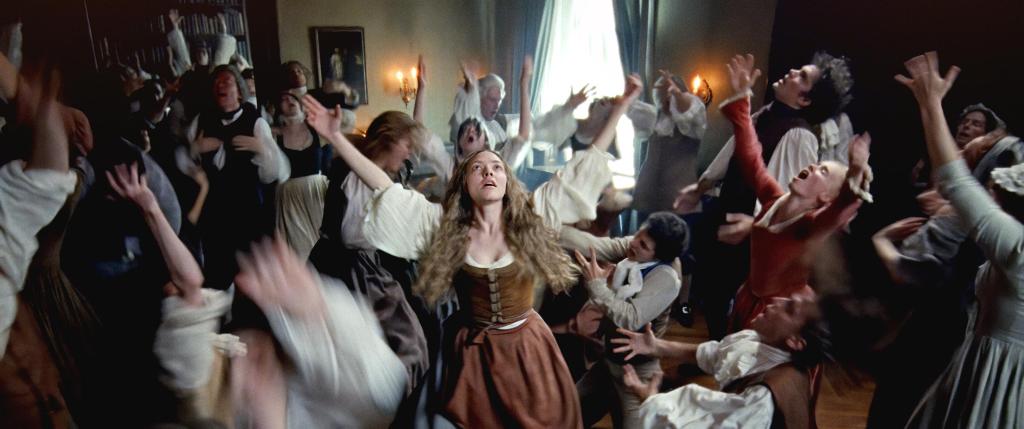
The Testament of Ann Lee is an exercise in understanding, even recreating, religious ecstasy. It is the story of the real life character of Ann Lee (Amanda Seyfried), a woman from 18th century Manchester who became the messianic leader of a subcult of Quakers called Shakers and, facing persecution in England, sought a new home for her group of religious fundamentalists in -where else- America.
What I found most interesting is that director Mona Fastvold approaches this story from two levels. At the external level, she paints a clear picture of how a charismatic leader can build a following of people who yearn to be unburdened of doubt and decision, to be told what to think and what to do and reassured that it will be enough. The entire movie is formally built from this angle, narrated by one of her followers (Thomasin McKenzie) as an unquestioning ode to her life and miracles. At the internal level, however, Fastvold subverts the elegiac tone of the “official” story by articulating how a desperate person can resort to mysticism to explain a suffering that is otherwise too brutal to comprehend. We see that Ann was subjected to sexual violence by her husband (Christopher Abbott) and gave birth to four children that all died as infants; it is not difficult to see how her vision of faith is one that sees sex as a root of corruption and chastity as a necessary protection against the world. Maybe today she would have filed for divorce, or sought therapy; in the 1740s, how many alternatives did she have? Amanda Seyfried is incredible in this role, playing the unflinching certainty of a true believer while occasionally showing glimmers of underlying frailty.
The Testament of Ann Lee is a deeply musical film, although I don’t think anyone would describe it as “a musical”. The songs are not showtunes, but folkloric tunes inspired by actual Shaker hymns, with repetitive lyrics meant more to inspire a religious trance than to tell a story, and also unlike in a musical, the characters do not sing to us or to a diegetic audience, but to their god, using music as a way of communing with a spiritual plane.
It is a movie that is difficult to classify and often challenging to watch, but Seyfried’s performance and the energy of the musical numbers are well worth your time.
The Testament of Ann Lee on IMDb
El testamento de Ann Lee (2026)
El testamento de Ann Lee trata de entender, incluso recrear, el concepto de éxtasis religioso. Es la historia real de Ann Lee (Amanda Seyfried), una mujer que en el Manchester del siglo XVIII se convirtión en la mesías de una subsecta de cuáqueros llamados Shakers. Ante la persecución que sufrieron en Inglaterra, buscó un nuevo hogar para su grupo de fundamentalistas religiosos en América (¿dónde si no?).
Lo más interesante es que Mona Fastvold, la directora y guionista, enfoca la historia desde dos ángulos. Desde el ángulo externo, explica claramente cómo un líder carismático es capaz de reunir un séquito de gente que ansía desprenderse de sus dudas y decisisiones, que alguien les diga lo que tienen que hacer y les prometa que será suficiente. Todo el aspecto formal de la película sigue esta perspectiva, al estar narrada por una de sus seguidoras (Thomasin McKenzie) con un relato incondicional de su vida y milagros. Desde el ángulo interno, sin embargo, Fastvold subvierte el tono elegíaco de la historia “oficial” sugiriendo que una persona desesperada puede acabar recurriendo al misticismo para explicar un sufrimiento cuya brutalidad sería de otra manera inconcebible. Vemos la violencia sexual que Ann sufrió a manos de su marido (Christopher Abbott) y que dio a luz a cuatro hijos de los cuales ninguno llegaría a vivir un año; no sorprende pues que su visión de la fe contemple el sexo como la raíz de toda corrupción y la castidad como una protección necesaria ante los males del mundo. Quizás hoy en día habría pedido el divorcio o buscado terapia; en 1740, ¿cuántas alternativas tenía? Amanda Seyfried es increíble en ese papel, en la forma en que interpreta la certeza absoluta de una fanática a la vez que deja entrever algún que otro destello de fragilidad.
El testamento de Ann Lee es una película profundamente musical, aunque no creo que se pueda describir como “un musical”. Las canciones no son propias de Broadway, sino melodías folklóricas inspiradas por auténticos himnos Shaker, con letras repetitivas que buscan más inducir un trance religioso que contar una historia. A diferencia de los musicales, los personajes no nos cantan a nosotros, ni a un público diegético, sino a su dios, usando la música como método de comunión con el plano espiritual.
Es una obra difícil de clasificar y a veces también de ver, pero la interpretación de Seyfried y la energía de los números músicales merece la pena.
 The Film Tower