In the 1920s, in Oklahoma, the Native American Osage nation became rich thanks to the vast oil reserves of their land. Almost immediately, an entire industry sprang around them with the only purpose of parting them from their money through any means necessary. Some white men sold exorbitantly overpriced products or services to the Osage. Some white men had Osage people declared legally incompetent and appointed themselves guardians of their fortune. Some white doctors took on Osage patients, often afflicted with heart disease or diabetes, and kept them sick, the better to keep fleecing them. Other white men married Osage women, then waited until their poor health took them away to inherit their fortune. And, if health didn’t do it, they would engineer poisonings, or accidents, or suicides to steer the supposed hand of fate, wiping out entire bloodlines to ensure that all their fortune would converge on one person.
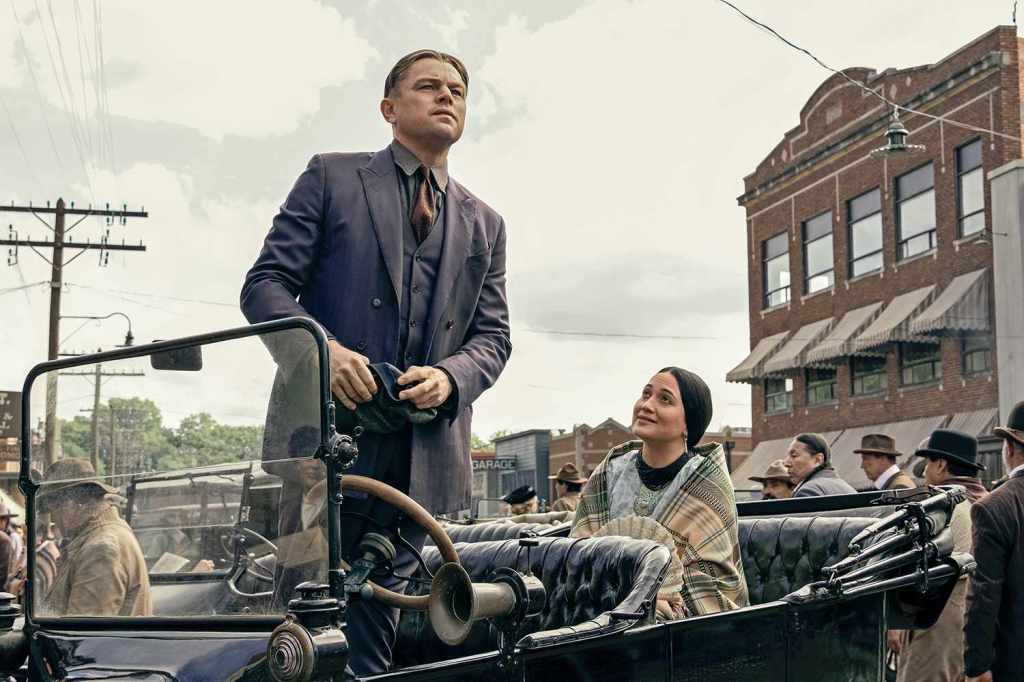
Martin Scorsese, in his latest three-and-a-half-hour epic, enters this story through Ernest Burkhart (Leonardo DiCaprio), a WWI vet who returns to America to work for his uncle, William Hale (Robert De Niro), an Oklahoman magnate who has amassed a fortune by using all the evil work outlined above and more. Together they set their sights on Mollie Brown (Lily Gladstone), an important Osage woman set to inherit all sorts of lands and riches from her extended family. Ernest seduces and marries her, which sounds like jackpot but is in fact only the first step in the plan. Whatever the pleasures of the Brown estate, it will continue in Osage hands as long as Mollie’s mother and sisters draw breath.
Over the course of its massive runtime, Killers of the Flower Moon lays bare -in excruciating detail- the cruelty with which white people bled Native Americans dry, figuratively as well as literally, for the crime of having wealth that they wanted for themselves, as well as the Osage’s helplessness in the absence of any local, estate or federal authority with even a passing interest in helping them (“It is easier to convict a man for kicking a dog than for killing an Indian”, a character remarks at one point).
The problem, for me, is that as powerful as the movie is, as ruthlessly as it condemns the actions of its white protagonists, it remains firmly the story of Burkhart and Hale. The movie never feels like it’s justifying their actions, much less condoning them, but it’s the old true crime problem: it is still taking three and a half hours to study the perpetrator. Lily Gladstone, who was already great in Certain Women and Reservation Dogs, delivers a phenomenal performance of heart-rending tragedy, yet her Mollie all but steps out of the movie halfway through. Scorsese makes only a temporary effort to wonder what she thinks of all that is happening. DiCaprio is convincing as an amoral snake whose greed appears unaccompanied by intellect; De Niro, meanwhile, is amazing in the way he weaponizes his charming old man persona to mask a ravenous bloodthirst. Together they carry the film, but I remain convinced that over 206 minutes it would have been possible to tell this story including Mollie’s own perspective.
Lastly, besides the story’s significance and denunciation, I will also point out how wonderful it is to see a movie that looks like a movie: faces are lit, objects cast shadows, shots are composed with intention, scenes are blocked so as to contribute to the storytelling. These are all the most basic building blocks of a movie, but the algorithm-driven slop that so many streamers put out has made them stand out.
Killers of the Flower Moon on IMDb
Los asesinos de la luna (2023)
En los años veinte, en Oklahoma, la nación nativa de los Osage se volvió rica gracias a la inmensa cantidad de petróleo que contenían sus tierras. Casi de inmediato surgió toda una industria a su alrededor, destinada enteramente a desvalijar a los nativos de una forma u otra. Algunos hombres blancos les vendían productos o servicios exorbitantemente caros a los Osage. Algunos hombres blancos se las arreglaban para declarar legalmente incompetentes a los Osage y se nombraban a sí mismos como guardianes de su fortuna. Algunos médicos blancos atendían a pacientes Osage, a menudo afectados por enfermedades cardíacas o diabetes, y se aseguraban de que siguieran enfermos para manipularlos mejor. Otros hombres blancos se casaban con mujeres Osage y luego esperaban a que su mala salud se las llevara, para heredar así su fortuna. Si la salud no les fallaba, entonces se las arreglaban para que sucedieran misteriosos envenenamientos, o suicidios, o accidentes, borrando de la faz de la tierra familias enteras para que su riqueza acabara en manos blancas.
Martin Scorsese, en su gran opus de tres horas y media, entra en esta historia a través de Ernest Burkhart (Leonardo DiCaprio), un veterano de la Primera Guerra Mundial que vuelve a los Estados Unidos para trabajar para su tío, William Hale (Robert De Niro), un magnate de Oklahoma que ha amasado una fortuna mediante todas las maldades descritas más arriba y algunas otras también. Los dos se fijan en Mollie Brown (Lily Gladstone), una importante mujer Osage que heredará todo tipo de tierras y bienes de su gran familia. Ernest la seduce y se casa con ella, pero eso no es más que el primer paso del plan. Por muchas comodidades que disfrute en la casa Brown, la fortuna no será realmente suya mientras la madre y las hermanas de Mollie sigan con vida.
A lo largo de su monumental metraje, Los asesinos de la luna describe con agotador detalle la crueldad con la que los blancos desangraron a los nativos, figurativa y literalmente, por el crimen de poseer riquezas que ellos querían para sí, así como el desamparo de los Osage en ausencia de ninguna autoridad local, estatal o federal con el más mínimo interés en ayudarlos (un personaje señala en una escena: “Es más fácil condenar a alguien por maltratar a un perro que por matar a un indio”).
El problema, para mí, es que por poderosa que sea la película, por enérgicamente que condene los actos de sus protagonistas blancos, no deja de ser la historia de Burkhart y Hale. Nunca justifica ni excusa sus crímenes, desde luego, pero es la misma problemática de las series de true crime: al final se trata de pasarse tres horas y media estudiando al criminal. Lily Gladstone, que ya fue genial en Certain Women o Reservation Dogs, es un genio de la interpretación que transmite una profundísima tragedia, pero Mollie prácticamente abandona la película a la mitad. DiCaprio convence como una sabandija amoral cuya codicia no viene acompañada de intelecto; De Niro, por su parte, lo borda aprovechando una fachada de anciano bonachón que esconde una sed de sangre insaciable. Juntos llevan todo el filme a sus espaldas, pero estoy convencido de que a lo largo de 206 minutos habría sido posible incluir la perspectiva de Mollie.
Por último, además de la importancia y la denuncia de la historia, también cabe señalar la perfección técnica de Scorsese: en esta película ha trabajado gente que ha iluminado los rostros, compuesto los planos y organizado los decorados para contar una historia. Son los elementos más básicos posibles de una película, pero el “contenido” algorítmico que producen los streamers hace que llame la atención el cine de verdad.
 The Film Tower