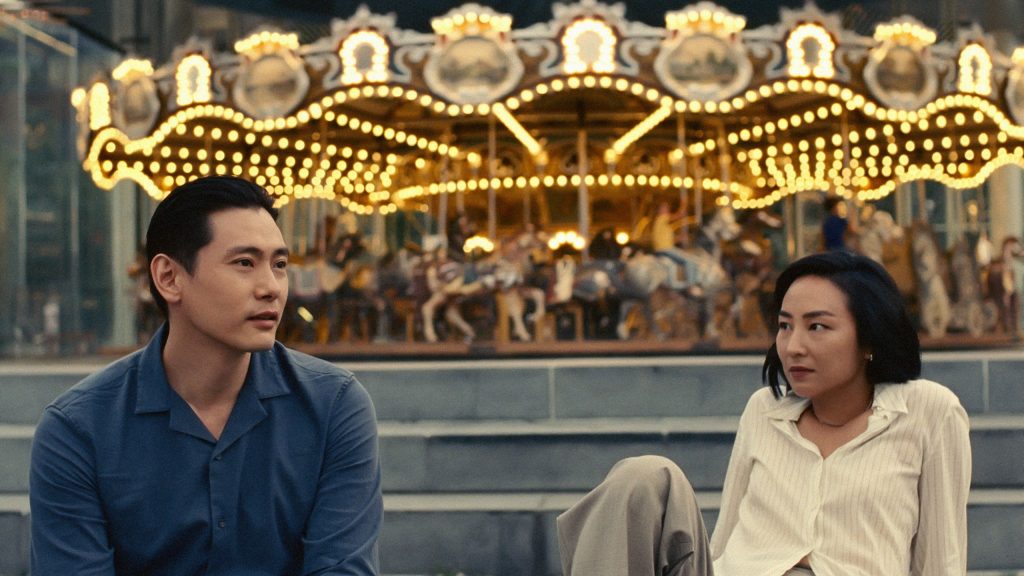
This is one of those movies that you’ll want to treasure. Past Lives exists in a dreamlike, suspended state of time: a magical moment where the memories of the past become alive, the circumstances of the present recede from view, and all the possible outcomes of the future appear tantalizingly within reach.
Through a series of flashbacks, we are introduced to Nora (Greta Lee), an aspiring writer who left her home in South Korea as a child to migrate with her family to Canada. She left behind Hae-Sung (Teo Yoo), her best friend, just as their relationship began to bloom into the ideal romance of the transition from childhood to adolescence. They reconnect twelve years later, online, their connection rekindled across continents before Nora, torn, decides to sever it and move forward with her American life.
Another twelve years pass, and now Ha-Seung travels to New York for the first time and meets up with Nora, who is now married to Arthur (John Magaro). They are all now in their thirties, with established lives, but in Nora and Hae-Sung’s reunion the air grows thick with all that was left unspoken, the dreams of all that could have happened. Celine Song, in what I find impossible to believe is her debut in feature film as director and writer, displays an astonishing ability to have her characters hold transcendent, heartfelt conversations that continue even when they switch to seemingly trivial subjects, as if all their exchanges -all the film, in fact- was one single thread followed from beginning to end. There is not a single moment of melodrama, not one exaggeration that stops the story from feeling grounded and lived in, but all the same the weight of an unrealized love hits with incredible emotional force.
Greta Lee and Teo Yoo deliver the kinds of performances that make it difficult after the fact to imagine anybody else doing them. Lee has to contend with a character rich in complexity and what comes across at first as contradiction: Nora’s profound love for Hae-Sung is evident, but its boundaries are tricky to chart, as much to her as to anybody else. Yoo’s task, for his part, is no easier to pull off: while Nora is more open and in touch with her feelings, Ha-Seung’s longing runs under the surface, in tortured gazes under a guise of affable cordiality.
Like I felt with Nomadland, I see the genius of Past Lives and I find that I can’t explain it. I can’t imagine how Song could take a story so mundane and make it feel earth-shattering, tell it with such restraint and still reach heights of emotions that much showier films can only hope to emulate. This must be the Brief Encounter of our era, our masterpiece of wounded romance.
Vidas pasadas (2023)
Esta es una de esas películas que hay que atesorar. Vidas pasadas existe en un momento suspendido en el tiempo, un espacio mágico en el que los recuerdos del pasado cobran vida, las circunstancias del presente se desvanecen en la distancia, y todos los posibles recorridos del futuro parecen estar al alcance de la mano.
A través de varios flashbacks conocemos a Nora (Greta Lee), una escritora en ciernes que abandonó su hogar en Corea del Sur cuando era niña para emigrar a Canadá con su familia. Dejó atrás a Hae-Sung (Teo Yoo), su mejor amigo, justo cuando su relación empezaba a transformarse de la amistad infantil al romance adolescente. Los dos se reencuentran por internet, doce años después, antes de que Nora decida volver a cortar sus lazos para entregarse por completo a su vida americana.
Pasan otros doce años, y en el presente Hae-Sung llega a Nueva York por primera vez para ver a Nora, que ahora se ha casado con Arthur (John Magaro). Los tres tienen treinta y tantos años y vidas establecidas, pero cuando Nora y Hae-Sung se reencuentran el aire se carga con todo lo que no se han dicho, todo lo que podría haber sido. Celine Song, que escribe y dirige lo que por increíble que parezca debe de ser su primer largometraje, demuestra una pericia inusitada en la forma en que sus personajes sostienen conversaciones emotivas y trascendentales que prosiguen incluso después de que hayan cambiado de tema y pasen a charlar de cosas aparentemente superficiales, como si todas sus discusiones, o toda la película, fueran un solo hilo que seguimos de principio a fin. No hay ni un momento de melodrama, ni una exageración que se haga poco realista, y aun así el peso del amor no realizado impulsa la historia con una fuerza chocante.
Greta Lee y Teo Yoo actúan los dos de tal manera que ya no se puede imaginar a nadie más en sus papeles. Lee debe lidiar con un personaje rico en complejidades y algo que a primera vista puede parecer contradictorio: es evidente lo mucho que Nora quiere a Hae-Sung, pero los límites de su amor son difíciles de trazar, para ella misma tanto como para nosotros. Yoo, por su parte, tampoco lo tenía fácil: mientras que Nora es más abierta y expresa mejor sus sentimientos, los de Hae-Sung fluyen bajo la superficie, expresados a través de miradas llenas de anhelo.
Igual que me pasó con Nomadland, veo la genialidad de Vidas pasadas y no sé cómo definirla. No sé cómo Song ha sido capaz de tomar una historia tan mundana y hacer que parezca colosal, contarla con tanta serenidad y a la vez alcanzar una intensidad que muchas películas más llamativas solo pueden soñar. Es el Breve encuentro de nuestra era, una obra maestra del romance herido.
 The Film Tower