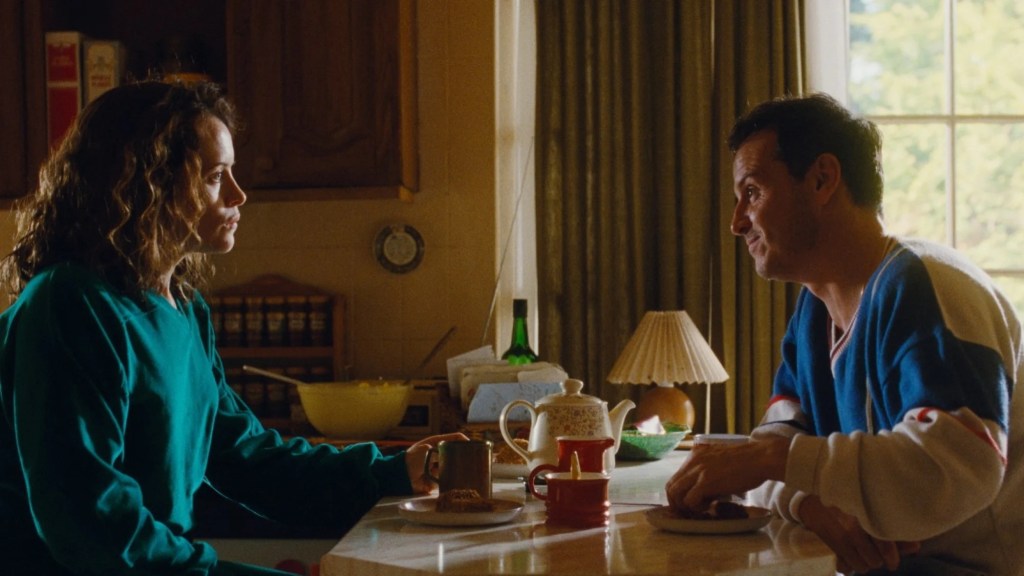
All of the marketing and discourse around All of Us Strangers has revolved around its passionate love story, between its protagonist Adam (Andrew Scott), a lonely writer in his forties, and Harry (Paul Mescal), a younger man and his only neighbor in an otherwise eerily empty London high-rise. Maybe because telling people up front that this movie will tear out your heart and crush it through a garlic press might not sell as many tickets! But where it really shines, where it becomes an arrow shot straight into your chest, is when it talks about family and regret: in a flight of magical realism, Adam begins to see his parents, who died in a car accident when he was twelve.
No explanation is given or needed; all that matters is that these encounters are real to Adam, who has spent his life carrying this loneliness into adulthood and is perhaps now manifesting his own closure where none could realistically be found. Adam’s parents (played by Claire Foy and Jamie Bell, both incredible) welcome him as if nothing had happened, even though he is now older than they ever were, and talk to him as though he’d just been away for some time.
The most basic concept at play -getting to talk to people you lost a long time ago- is emotional enough by itself, so much so that it becomes a recurring dream for anyone who has suffered loss: all that is left unspoken, all the questions that will remain unanswered forever, the regrets over what you did or did not do. Andrew Haigh makes these scenes even more devastating by diving head first into several common but underexamined facets of the gay experience: in addition to having to imagine what coming out to his parents would have been, Adam also talks about the burden of having grown up in emotional hiding, the isolation that he characterizes as a knot in your chest that you grow used to carrying with you.
It is rare to see a film so entirely without subtext: it is all text, all its themes are not only verbalized but explicitly put under discussion. They are, in fact, all that is discussed, as Haigh has no time for small talk and alternates scenes with Harry and Adam’s parents with no fluff in between. Truth is, I don’t blame it for what you might qualify as heavy-handedness. Yes, there are moments when everyone on screen is crying that sometimes tip from dramatic into overwrought, but then again everyone else in my screening was audibly sobbing just as much and as often as the characters themselves. Is a heavy hand bad when it works? Is it wrong to face these deep questions head on, even if we must create a fantasy in which they are answered?
Roger Ebert said that “no good movie is truly sad”, referring to the fact that a good story will know how to get something out of sadness. All of Us Strangers still feels profoundly sad, perhaps because of the futility of trying to rewrite the past. But what a powerful feeling it is!
Where I will find fault is in a terrible ending that is uncalled for at best, detrimental to the film’s own themes at worst, but don’t let that dissuade you from watching it. All four actors are phenomenal in it, to the degree that by the end they can make us cry just with a look, and the atmosphere that blurs reality and fantasy will surely find a crack through which it will speak to you.
Desconocidos (2024)
Toda la publicidad y todas las conversaciones alrededor de Desconocidos se han centrado en la historia de amor entre su protagonista, Adam (Andrew Scott), un solitario guionista de cuarenta y tantos años, y el joven Harry (Paul Mescal), su único vecino en un bloque de apartamentos de Londres por lo demás totalmente vacío. ¡Seguramente decir a la gente que esta película te arrancará el corazón y lo machacará con un martillo hidráulico vendería menos entradas! Pero su mayor logro, lo que la convierte en un puñal que se te clava en el pecho, es su exploración de la familia y el arrepentimiento: en una demostración de realismo mágico, Adam empieza a ver a sus padres, que murieron en un accidente de coche cuando él tenía solo doce años.
No esperes explicaciones, porque no las habrá: lo que importa es que estos encuentros son reales para Adam, alguien que acarrea su soledad desde niño y que ahora por fin manifiesta una forma de atar cabos sueltos que la realidad no puede ofrecerle. Los padres de Adam (interpretados por Claire Foy y Jamie Bell, los dos increíbles) lo reciben en su casa como si nada, a pesar de que ahora él es mayor que de lo que ellos jamás llegarían a ser, y le hablan como si solo llevaran una temporada sin verse.
El concepto más básico (poder hablar con alguien que perdiste hace mucho tiempo) ya es lo bastante emotivo de por sí: todo lo que se quedó sin decir, las preguntas que ya nunca recibirán respuesta, el arrepentimiento por haber hecho o dejado de hacer algo. Andrew Haigh consigue además que estas escenas sean directamente devastadoras al enlazarlas con un personaje polifacético: Adam explica la soledad de vivir aislado como un nudo en el pecho con el que ha acabado aprendiendo a convivir.
Es inusual ver una película tan carente de subtexto: en Desconocidos todo es texto, toda la temática se debate expresamente. Es de hecho lo único que se debate, porque Haigh no pierde el tiempo en nada que no sea la sucesión de escenas de Adam con sus padres o Adam con Harry. Lo cierto es que no le echo en cara que se le pueda tildar de melodramático. Sí, hay momentos en los que todos los personajes están llorando que acaban rozando el exceso, pero lo cierto es que en el cine pude oír cómo todos los asistentes sollozaban tanto como los propios personajes. ¿Es malo apoyarse tanto en el drama si funciona? ¿Es menos efectivo por formular las preguntas básicas de nuestra experiencia explícitamente, incluso si hace falta inventarse una fantasía para darles respuesta?
Roger Ebert dijo que “ninguna buena película es verdaderamente triste”, refiriéndose al hecho de que las buenas historias saben cómo destilar algo edificante de la tristeza. Aun y todo, Desconocidos se me hizo profundamente triste, quizás por la futilidad de intentar reparar el pasado, pero la intensidad de la emoción es indiscutible.
Lo que sí discutiré es un pésimo final que en el mejor de los casos no viene a nada, y en el peor de los casos, sabotea la temática del resto de la historia; pero no por eso deja de merecer la pena. Los cuatro actores son fenomenales, hasta el punto de que hacia el final ya son capaces de hacerte llorar solo con una mirada, y la ambientación difumina la realidad y la fantasía de una forma que se las arregla para atravesar las defensas de cualquiera.

