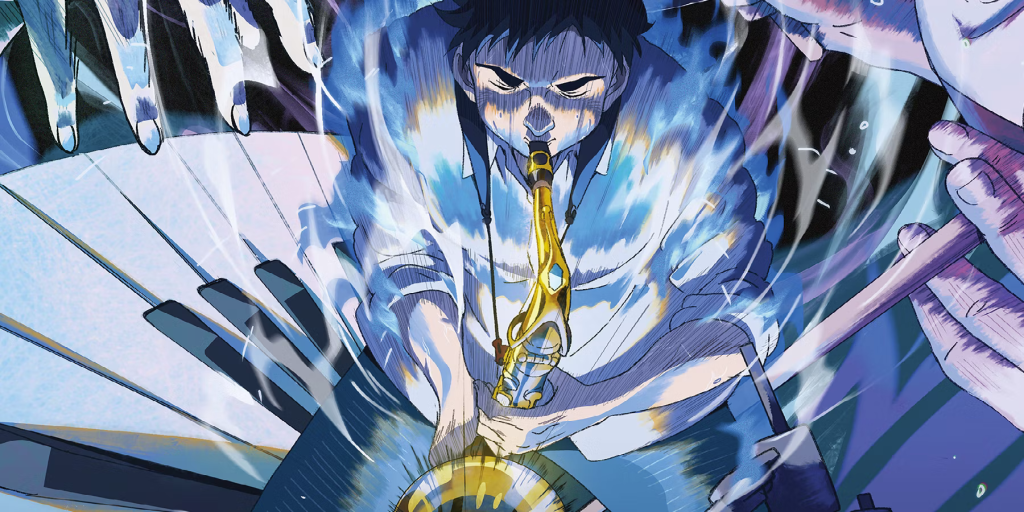
If you’re in the mood for a movie about a jazz band that isn’t a biopic, lets the music speak for itself, and is also an anime, then Blue Giant is here to fill that oddly specific niche. It presents us with Dai (Yuki Yamada, recently in Godzilla Minus One), a country kid who moves to Tokyo to try to make it as a jazz saxophonist and forms a band with two mates.
I liked the character dynamics between the three band players: Dai, kind-hearted, all talent and passion; Yukinori, haughty, the product of years of training and technique, and especially Tamada, so earnest, an absolute beginner who earns his keep through sheer perseverance. Seeing them grow and learn from each other is for the most part enough to keep the movie going, which is for the best as the movie’s approach to its plot is surprisingly light-touch, considering it’s adapting a (fraction of a) manga series.
The animation is perhaps what’s most interesting to discuss, because it has very high highs and very low lows. Let me start with the lows: although most of the film is animated in classic 2D anime style, there are select shots during the band’s performances that are made using cel-shaded 3D models, imitating 2D anime, and these are awful! They all stand out, they look wooden and static in their movement, and the characters’ faces are frozen in an inexpressive grimace, marring otherwise vibrant musical sequences. I suspect they may be motion-captured from real musicians (they have none of the hand-animated fluidity of, say, Belle), but even then, director Yuzuru Tachikawa should have realized that these simply do not capture a real person’s passion the way animation can.
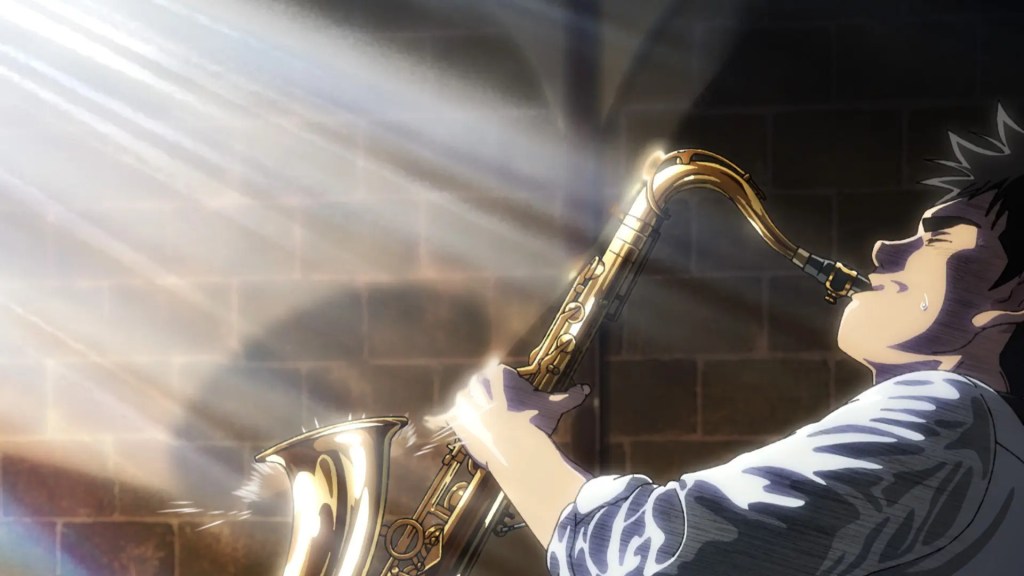
On the other hand, in addition to 3D shots the movie’s many music numbers also feature gorgeous traditional animation that go from black and white to technicolor and from realistic to abstract all during the same song, and these look phenomenal, so clearly the team wasn’t lacking the artistry necessary to bring the numbers to life.
The music, by real-life jazz pianist Hiromi Uehara, is as powerful a force as the animation itself, especially because Tachikawa does here what so few music-related movies dare to do: he lets every song play in full, even if it means stopping the story dead in its tracks to listen to it. I think many directors are afraid the audience will tune out, but if you’re making a movie about musicians, then it’s important to show why music is important to them, and that means letting it play out. Clocking it at two hours, the film dragged a bit for me, but not because of the time spent playing music, but because the characters’ arcs are relatively simple for the time spent on them.
All in all, Blue Giant does not quite fulfill its true potential, but the music and visuals make it worth a watch.
Blue Giant (2024)
Si te apetece una peli sobre una banda de jazz que no es un biopic, deja que la música hable por sí misma, y de paso es un anime, Blue Giant es probablemente lo único que responde a tan específica descripción. Es la historia de Dai (Yuki Yamada, a quien vimos recientemente en Godzilla Minus One), un adolescente de campo que se muda a Tokio para triunfar como saxofonista de jazz y acaba formando una banda con dos colegas.
Me gusta la dinámica entre los tres personajes: Dai, de buen corazón, todo talento y pasión; Yukinori, altivo, producto de años de estudio y práctica, y Tamada, un completo principiante que se gana el puesto gracias a su insistencia. Verlos crecer y aprender unos de otros basta para propulsar la película… afortunadamente, porque el argumento es de lo más ligero para ser la adaptación de una serie de manga.
La animación es probablemente lo más interesante, porque cuando es buena es muy buena y cuando es mala es muy mala. Empecemos con lo segundo: aunque casi toda la peli está animada al estilo anime clásico en 2D, hay planos durante las actuaciones de la banda que han animado con modelos 3D usando cel-shading, ¡y quedan fatal! Llaman la atención por lo ortopédico de sus movimientos y la inexpresividad de sus caras, estropeando secuencias por lo demás vibrantes. Sospecho que habrán utilizado captura de movimientos de músicos de verdad (no muestran la fluidez de la animación manual de, por poner un ejemplo, Belle), pero aun y todo el director Yuzuru Tachikawa debería haberse dado cuenta de que no capturan la pasión de una persona real como lo hace la animación.
Por el contrario, además de los planos en 3D los numerosos números musicales también despliegan una espectacular animación tradicional que pasa del blanco y negro al tecnicolor y del realismo a la abstracción en una sola canción. El despliegue visual es fenomenal y demuestra que al equipo no le faltaba el talento para dar vida a las actuaciones.
La música, compuesta e interpretada por la pianista de jazz Hiromi Uehara, es igual de poderosa que la animación, especialmente porque Tachikawa se atreve a lo que muchas películas musicales no: deja que todas las canciones se toquen por completo, aunque obligue a pausar la historia para escucharla. Creo que muchos directores piensan que si hacen eso los espectadores se aburrirán, pero si haces una peli sobre músicos, es importante enseñar por qué la música es importante para ellos, y eso se consigue viéndoles y escuchándoles tocar. Con dos horas de duración, Blue Giant se me ha hecho larga, pero no por la música sino porque el recorrido de los personajes es relativamente simple para el tiempo que se tarda en esbozarlo.
Al final, Blue Giant no consigue quizás alcanzar todo su potencial, pero la belleza de la música y el arte hacen que merezca la pena.
 The Film Tower