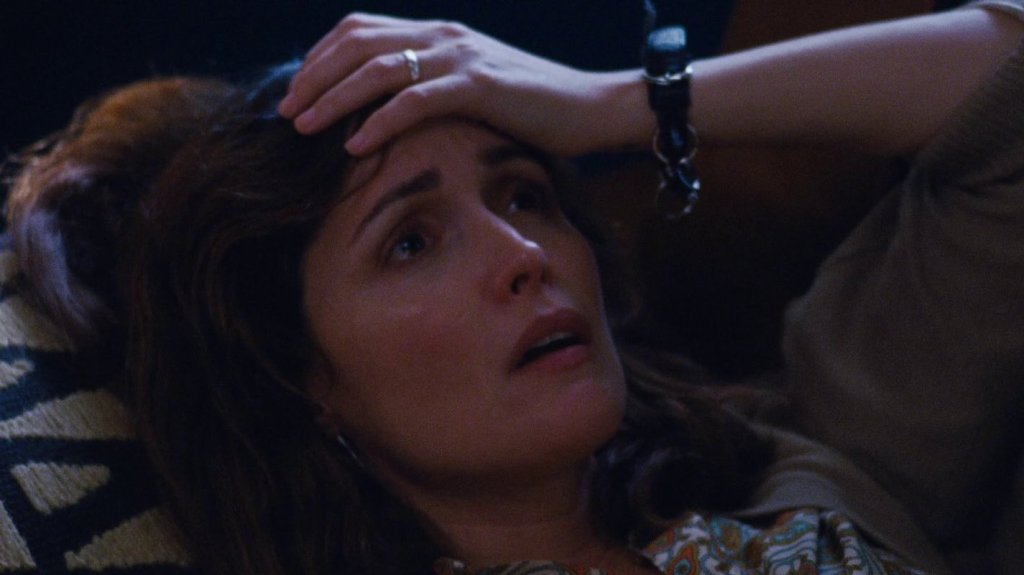
So what are the ethics of recommending a movie that is going to stress and devastate you in equal measure? Because this is one of those.
Out of what looks like a budget of $50 and a dream, writer and director Mary Bronstein has drawn a harrowing portrait of a woman buckling under the pressures of motherhood that nevertheless feels like an authentic testimony of a lived experience. The subject is Linda (Rose Byrne), a therapist who has to juggle the constant demands of her little daughter’s serious illness, her job, her household, and her own fraying mental health, while her absentee husband complains that she’s too dramatic. Things start out bad and only get worse.
Bronstein spends almost the entire movie with the camera right on Byrne’s face, letting her anxiety fill the entire screen with barely any room left to take in her surroundings, all the better to induce the claustrophobia that the character is feeling. Linda’s daughter, on the other hand, is an active participant in many scenes but never seen: we are at a stage where we do not see her as a human being but only as a problem to be managed.
These are devices that only works if you have an actor capable of sustaining an entire movie with their performance; it speaks in both Bronstein and Byrne’s favor that their cooperation is as successful as it is. Byrne’s craft, entirely devoid of ego, does not shy away from the uglier side of her character: you can see sometimes the selfishness that anybody will feel when pushed into a situation where their every waking moment must be dedicated to others. When Linda makes increasingly ill-advised choices, as the only way she finds of exerting control over her life is to walk away from a problem, Byrne does not seek to justify her but rather to show how some reactions are almost physiological in such a situation. The proof of her skill, however, is not in the big dramatic moments; I’m thinking of a scene in which she is trying to pay attention to a patient while fighting the urge to fall asleep that is alone worth any acting award in the world.
I’m not making it sound like a good time, am I? I guess it’s not, exactly (there is one hamster-involved incident that is hilarious), but it’s an absorbing character study that borders on horror. The way it looks at parenthood and the crushing social pressure that we apply to mothers will resonate with any mom or caretaker, even if they haven’t experienced such extremes, and while it does not gloss over our worst instincts I think it shows grace in pointing out that no one can manage a crisis perfectly without help.
If I Had Legs I’d Kick You on IMDb
Si pudiera te daría una patada (2026)
¿Es ético recomendar una película que te va a estresar y demoler a partes iguales? Porque esta es una de esas.
Con un presupuesto que yo estimaría en 50$ y un par de bocadillos, la guionista y directora Mary Bronstein pinta el retrato descarnado pero a la vez compasivo de una mujer que se derrumba bajo la presión de la maternidad. Se trata de Linda (Rose Byrne), una psicóloga que debe compaginar las exigencias constantes de la grave enfermedad de su hija pequeña, su trabajo, la casa, y su propia y deteriorada salud mental, mientras su marido ausente se queja de que le gusta exagerar. Las cosas empiezan mal y solo van a peor.
Bronstein se pasa prácticamente toda la película con la cámara pegada a la cara de Byrne, dejando que su ansiedad se expanda hasta ocupar toda la pantalla, ocultando el entorno para inducir la claustrofobia que siente el personaje. La hija de Linda, por el contrario, participa activamente en muchas escenas sin que la veamos jamás: llegamos en una fase en la que ya no la podemos ver como un ser humano, solo como un problema a gestionar.
Son técnicas que solo funcionan si la actriz es capaz de llevar toda la obra sobre sus hombros. Es mérito tanto de Bronstein como de Byrne que su colaboración haya resultado tan efectiva. La hercúlea interpretación de Byrne, enteramente carente de ego, no esconde las aristas de su personaje: deja ver el egoísmo que tienta a cualquier persona obligada a dedicar cada momento de su existencia a los demás. Cuando Linda toma decisiones cada vez más cuestionables, a medida que huir de las situaciones desagradables se convierte en la única manera que tiene de ejercer cierto de grado de control sobre su vida, Byrne no busca justificarse sino ilustrar que a veces ese tipo de reacciones son prácticamente fisiológicas. Dicho eso, la prueba de su talento no reside solo en los momentos más dramáticos: pienso en una escena en la que intenta prestar atención a una paciente sin quedarse dormida que ya merece cualquier premio de actuación del mundo.
Explicada así la peli probablemente no suene muy apetecible (hay que decir que hay un incidente relacionado con un hámster que me hizo reír) pero de verdad es un análisis de personaje que roza el terror. Cualquier madre o cuidadora, aunque no haya sufrido tales extremos, se identificará con la forma en la que se retrata la asfixiante presión social que acompaña a la maternidad. Aunque no maquilla nuestros peores instintos, demuestra infinita compasión al señalar que nadie puede llevar una crisis irreprochablemente sin ayuda.
 The Film Tower