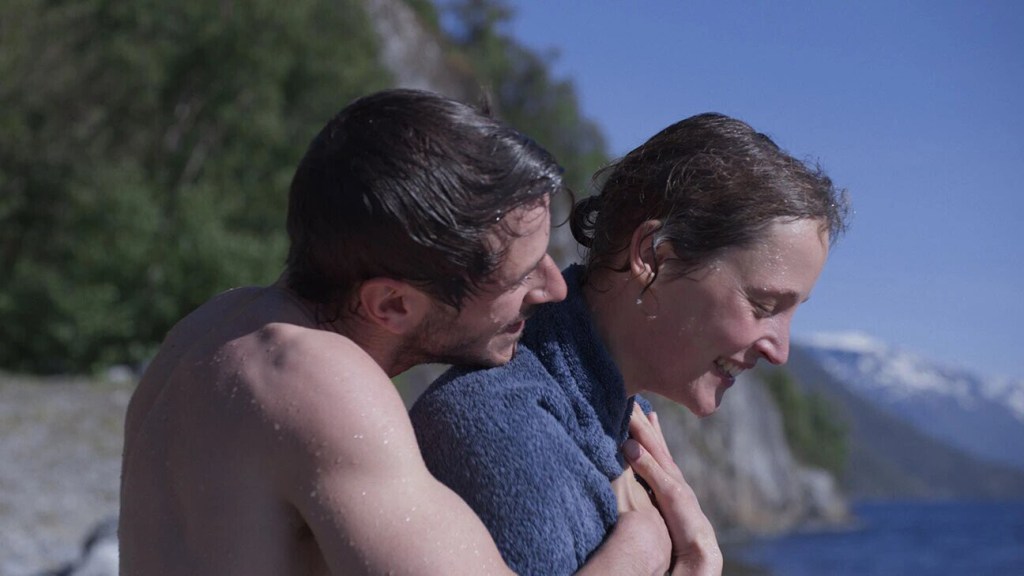
Hélène (played by the charismatic VIcky Krieps) suffers from a pulmonary disease that is difficult to explain but easy to understand: her lungs are ceasing to function and she will die unless she gets a double transplant. She will also die if she does get the transplant and something goes wrong, or her body rejects the lungs, or she gets an infection in the months following the surgery. There are so many paths that lead to her extinction, but because there is one path -however unlikely- to her survival, people around her cling to it with a fervor that she feels is blinkered. This is especially true for her husband, Mathieu (the late Gaspard Ulliel), whose inability to conceive of a future without Hélène sends him into angry outbursts at any mention of death.
Eventually, Hélène seeks escape from her (figuratively, as well as literally) suffocating situation in Paris and flees to the Norwegian fjords, to meet a blogger who suffered through cancer and seems uniquely poised to understand her plight. Her relationship with Bent (Bjorn Floberg) is not romantic, although certainly it will look that way to Mathieu, if he even finds out about it. Ultimately, what Hélène wants is to gain some clarity on her own circumstances, explore her own feelings about what is happening to her without the weight of other people’s concern.
Hélène comes to life thanks in no small part to Vicky Krieps (recently in The Three Musketeers), who plays her with a world-weariness that seems to carry years of resignation. Gaspard Ulliel too is excellent, playing now the opposite role of his turn in It’s Only the End of the World, although his every appearance triggers a painful reminder of his loss, the unintended shadow of the many great performances that lay ahead of him. It is unfortunate, then, that the scenes with the two of them are one of the movie’s weakness: although the actors work well, the arguments between them become circular, repetitions of the same character statements that interrupt the story rather than moving it along.
Still, Emily Atef has put together a touching, and more than a little harrowing, reflection on the end of our life and its reverberating effects on those around us. The conversation is difficult but necessary, and she tackles us with the sensitivity it deserves.
Más que nunca (2023)
Hélène (interpretada por la carismática Vicky Krieps) padece una enfermedad pulmonar que resulta difícil de explicar pero fácil de resumir: sus pulmones fallan y morirá si no consigue un transplante doble, o si consigue el transplante y algo sale mal con la operación, o si su cuerpo rechaza los pulmones nuevos, o si pilla una infección al poco tiempo. Hay muchísimos caminos que llevan a su muerte, pero como hay uno (por improbable que sea) que lleva a su supervivencia, todo el mundo a su alrededor se aferra a él con un fervor que a ella le resulta egoísta. Esto le provoca conflictos principalmente con su marido, Mathieu (el tristemente fallecido Gaspard Ulliel), cuya incapacidad para imaginar un futuro sin Hélène le provoca accesos de cólera a la mera mención de la muerte.
Hélène acaba por huir de esa situación tan (metafórica y literalmente) asfixiante en París y marcharse a los fiordos noruegos, para conocer a un bloguero que sufrió cáncer y parece ser el único que la comprende. Su relación con Bent (Bjorn Floberg) no es romántica, aunque desde luego se lo parecerá a Mathieu si alguna vez llega siquiera a enterarse. En última instancia, lo que quiere Hélène es adquirir cierta perspectiva sobre sus propias circunstancias, explorar lo que piensa acerca de lo que le pasa sin el lastre de la preocupación de los demás.
Vicky Krieps (a la que vimos hace poco en Los tres mosqueteros) da vida a la protagonista como si cargara con el peso del mundo a sus espaldas. Gaspard Ulliel, aquí en un papel opuesto al que le tocó en Solo el fin del mundo, también ofrece una interpretación excelente, aunque cada vez que aparece nos recuerda su trágica pérdida, una sombra de las muchas grandes actuaciones que le quedaban por delante. Es una pena, por lo tanto, que las escenas con los dos sean el punto débil de la película: aunque ellos trabajan bien, las discusiones entre sus personajes se acaban volviendo circulares a medida que repiten los mismos argumentos una y otra vez.
En todo caso, Emily Atef ha firmado una reflexión sensible, por dura que sea, sobre el final de nuestra vida y su efecto en aquellos que nos rodean. Es una conversación tan difícil como necesaria, y ella la aborda con la delicadeza que se merece.
 The Film Tower