So this is an odd one that you’re probably never going to come across in your life, but I saw it so I might as well tell you about it.
The Father of the Milky Way Railroad (Ginga Tetsudo no Chichi) is a biographical melodrama about Kenji Miyazawa, a beloved Japanese author from the early 20th century… ‘s father. They tell you right at the outset that Kenji died at the age of 37, so, you know, manage your expectations! The conceit of taking the point of view of his father gives the movie an excuse to narrate Miyazawa’s entire, short life, from being raised solely to inherit a pawnbroker’s business in a rural town to gaining an education, becoming an agricultural consultor, a Buddhist scholar, a musician, a poet, and finally a writer of children’s book, “the Hans Christian Andersen of Japan”.
While Miyazawa (heretofore unknown to me) is a fascinating figure in his tormented versatility, the movie of his life is irregular, with rote, purely biographical stretches interrupted by over-the-top, melodramatic scenes with lots of shouting -and, yes, sincerely moving moments that stand out from the rest. It seems that the poor man’s life offered no shortage of tragedies to mine for drama, seeing from what’s on display, but does it say something about me or about the film that I still teared up at pretty much every one of those scenes, even knowing they were going for the easiest heartstrings to tug?
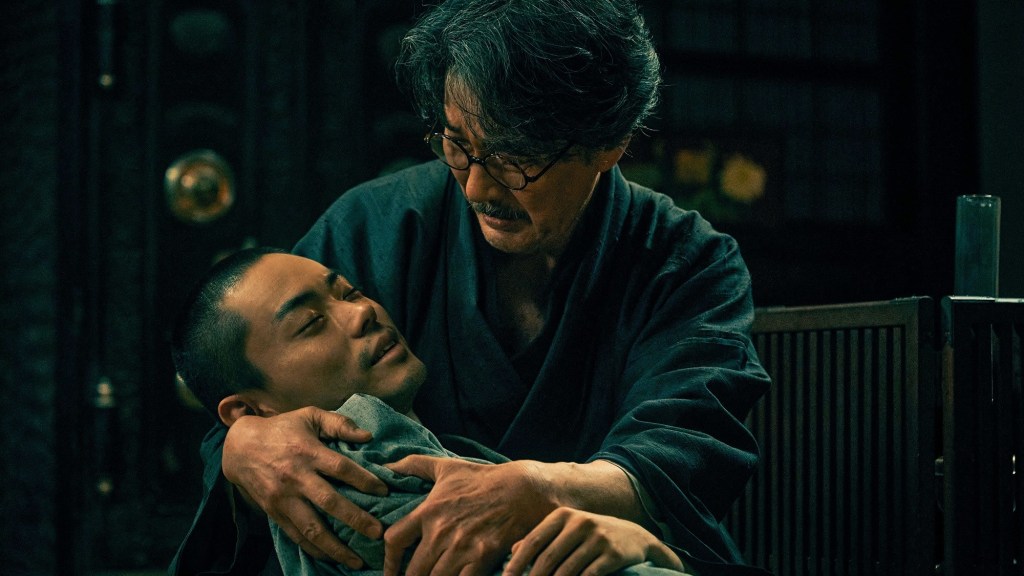
The real treasure of The Father of the Milky Way Railroad is its two lead actors: Koji Yakusho, whom you saw (or must see) in Perfect Days, as the long-suffering father, and Masaki Suda, whom you saw (or must see) in A Hundred Flowers and who was, improbably, the heron in The Boy and the Heron, as the conflicted Kenji. They are both gifted actors, as you can see from how they elevate their quiet moments with their natural gravitas, or how they take control of the most dramatic scenes to stop them from taking off into the stratosphere. Nana Mori also has a delightful turn as Toshi, Kenji’s favorite sister, and her you may have seen in the The Makanai Netflix show or heard in Weathering with You, as long as we’re naming resumes.
It’s hard to recommend a movie that swerves so wildly from Wikipedia article to TV drama, even with two great performances at its core. I will say that trapped in the confines of a trans-Atlantic flight, it made me cry like six times, so make of that what you will!
The Father of the Milky Way Railroad on IMDb
The Father of the Milky Way Railroad (2023)
Esta es una de esas raras que nunca vas a encontrar en la vida, pero yo la he visto así que te la cuento.
The Father of the Milky Way Railroad (“El padre del tren de la Vía Láctea”) es un melodrama biográfico sobre… no Kenji Miyazawa, un querido autor japonés de principios del s. XX. que escribió cuentos infantiles, entre ellos “El tren nocturno de la Vía Láctea” que da título a la película… sino sobre su padre. Te avisan ya desde el principio de que Kenji murió a los 37 años, así que, pues nada, toca controlar las expectativas. La idea de tomar el punto de vista del padre del sujeto le da a la peli la excusa para narrar su vida entera, desde crecer como heredero de una casa de empeños en un pueblo del interior rural de Japón hasta conseguir una educación y convertirse en consultor agrícola, erudito del budismo, violonchelista, poeta, y finalmente escritor, “el Hans Christian Andersen de Japón”.
Aunque Miyazawa (hasta ahora desconocido para mí) es una figura fascinante por su atormentada versatilidad, la película de su vida es irregular, marcada por pasajes biográficos rutinarios interrumpidos por escenas melodramáticas a más no poder llenas de gritos… y también momentos sinceramente conmovedores que destacan sobre todos los demás. Se ve que en la vida de este pobre hombre no faltaron las tragedias con las que alimentar el drama, pero ¿qué pasa si casi todos esos dramas acaban resultando emotivos de verdad?
El verdadero tesoro del filme son sus dos actores protagonistas: Koji Yakusho, a quien has visto (o debes ver) en Perfect Days, en el papel de Miyazawa padre, y Masaki Suda, a quien has visto (o debes ver) en A Hundred Flowers y quien puso la voz, quién lo iba a decir, a la garza en El chico y la garza, en el papel de Kenji Miyazawa. Son dos actores superdotados que demuestran su talento cuando elevan momentos discretos con silenciosa elegancia, o cuando toman las riendas de las escenas más exaltadas sin caer en el histrionismo. También cabe mencionar a Nana Mori como Toshi, la hermana favorita de Kenji, y ya que estamos repasando currículums a ella la hemos visto en la serie Makanai de Netflix o en El tiempo contigo.
Cuesta recomendar una película que da bandazos entre “artículo de Wikipedia” y “telefilme trágico” tan atropelladamente, aunque pueda presumir de dos grandes actores. Eso sí, si te apetece llorar en medio de un vuelo transoceánico, ¡es lo que buscas!
 The Film Tower