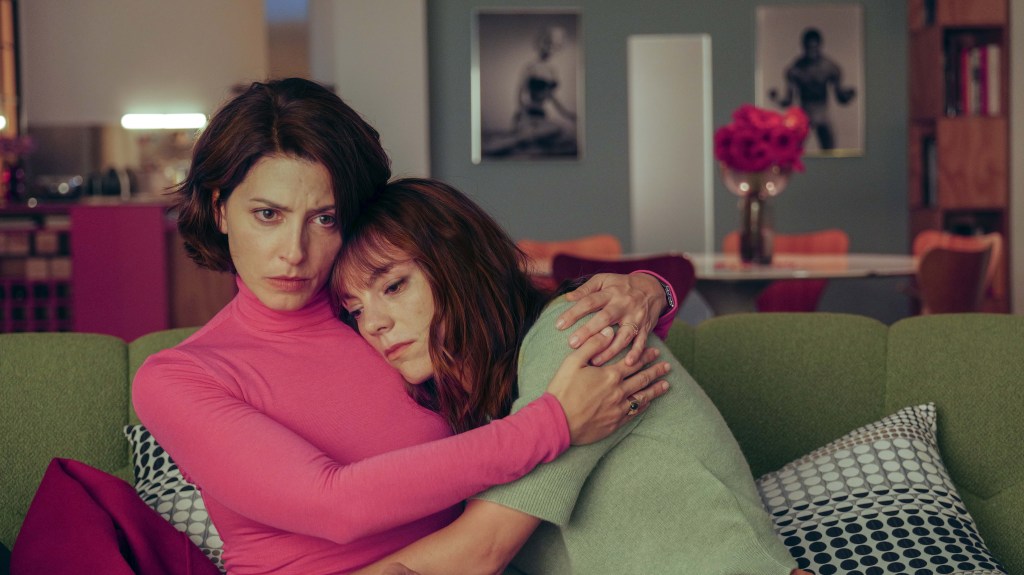
After his foray with American actors in The Room Next Door, which did not do much for me, Almodóvar is back in familiar territory. This time he is telling the story of a movie director called Elsa (Bárbara Lennie), who suffers from debilitating migraines and is stuck directing commercials but finds a new source of inspiration when she decides to start writing about the struggles of her friends Patricia (Victoria Luengo) and Natalia (Milena Smit). The twist is that this story is itself being written by a different director/screenwriter, Raúl (Leonardo Sbaraglia), stuck in his own rut, who is himself inspired by his lifelong assistant Mónica (Aitana Sánchez-Gijón).
I’m not ashamed to say that I normally hate framing devices and immediately lower my expectations when I see a TV show start with one, not because there’s anything inherently wrong with the device itself but because most often writers use them as lazy crutches to add some complexity to stories that have none. Good writers take the concept of the story-within-a-story and build a metanarrative where both plots inform each other, as is the case here. Think about how many movies or TV shows with two narrative levels could jettison one of them entirely without suffering for it; in Bitter Christmas, you cannot understand one story without the other. You can even add a third meta layer if you consider Almodóvar himself, the third writer/director behind the first two, and how he may be drawing them in his own image.
Elsa is a compelling protagonist, whose malleability in the hands of a present writer does not detract from her agency as a character. It helps that Bárbara Lennie and Aitana Sánchez-Gijón both act circles around literally everyone else in the cast: there’s a particularly galling example early in the film in which Elsa and her boyfriend (Patrick Criado) are both moved to tears when hearing a beautiful song (a very Almodóvar moment, stopping a movie dead in its tracks to listen to a real-life pop star sing like an angel -wouldn’t you if you could?) and having both their faces next to each other invites a comparison that is almost cruel to Criado.
After staying strong for most of its runtime, the movie lost me in the third act, where an increasingly meta dispute between Raúl and Mónica adds a new conflict that I think is interesting enough but not sufficiently developed in the short time it is given. This is not an astute observation on my part: Mónica says as much in dialogue, and even offers some suggestions as to how to fix the story, but I will say that lampshading a weakness in your script does not absolve you from having to fix that weakness!
Still, despite a somewhat derailed ending, a Pedro Almodóvar movie is always a guarantee of interesting themes, gorgeous production design and cinematography, musical lyricism… the craft of filmmaking, in short.
Amarga Navidad (2026)
Tras la aventura americana de La habitación de al lado, que a mí me dejó frío, Almodóvar vuelve a terreno conocido. Esta vez cuenta la historia de una directora de cine llamada Elsa (Bárbara Lennie) que sufre terribles migrañas mientras dirige anuncios pero que encuentra una nueva fuente de inspiración cuando empieza a escribir sobre el sufrimiento de sus amigas Patricia (Victoria Luengo) y Natalia (Milena Smit). El giro es que esta historia a su vez está siendo escrita por otro director y guionista, Raúl (Leonardo Sbaraglia), él mismo carente de inspiración hasta que se inspira también en su asistente de toda la vida, Mónica (Aitana Sánchez-Gijón).
No tengo ningún pudor en decir que normalmente odio la técnica del framing device o narración enmarcada, no porque tenga nada de malo en sí sino porque la mayoría de las veces es un atajo que usan los guionistas para inyectar algo de complejidad en una historia que no la tiene: piensa en todas esas series de televisión que empiezan con un interrogatorio en el que los personajes van desvelando poco a poco una trama que no tendría mayor interés de narrarse en orden. Los buenos guionistas saben elaborar una metanarrativa en la que las dos historias se influyan entre sí, como en esta película. Podemos incluso añadir una tercera capa narrativa si consideramos al propio Almodóvar, el tercer director y guionista que manipula a los otros dos y los ha creado quizás a su imagen y semejanza.
Elsa es una protagonista compleja, cuya maleabilidad a manos de un escritor presente en la historia no disiminuye su integridad como personaje. Ayuda que Bárbara Lennie y Aitana Sánchez-Gijón den vueltas a todo el resto del reparto en lo que a actuar se refiere: hay un caso especialmente flagrante al principio de la peli en el que Elsa y su novio (Patrick Criado) se emocionan hasta el llanto al escuchar una hermosa canción (un momento muy Almodóvar, parar la peli de golpe para escuchar a una estrella del pop de la vida real cantar como un ángel; ¿no harías tú lo mismo si pudieras?) y ver sus rostros uno al lado del otro invita a una comparación que es casi cruel hacia Criado.
Tras dos actos bastante sólidos, el tercero me decepcionó con una disputa aún más meta entre Raúl y Mónica que añade un conflicto de último minuto que no carece de interés pero que no se desarrolla lo suficiente en el poco tiempo que se le da. No es una observación original: la propia Mónica lo dice expresamente, e incluso sugiere posibles soluciones para mejorar el argumento, pero diré que señalar un fallo en tu propio guion no te exime de tener que resolverlo…
En todo caso, a pesar de un final algo débil, una película de Pedro Almodóvar siempre es garantía de temas profundos, increíble diseño de producción y cinematografía, lirismo… Lo que compone el cine, al fin y al cabo.

