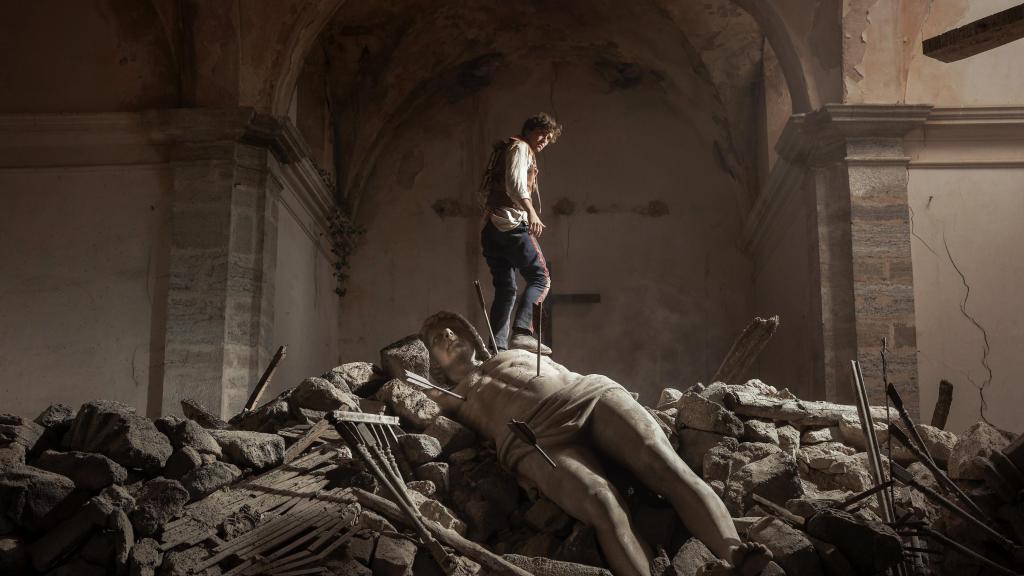
Sometimes I wonder if there’s any benefit to explaining the premise of a movie so popular as this one, because surely you’ve already heard enough about it by now? But what if you haven’t and I lose this chance to recommend an incredible experience? So anyway, La Bola Negra is a historical epic structured around the lives of three gay men at different points of Spanish modern history, all linked by Federico García Lorca’s lost play of the same name, of which only a dramatis personae and one page of dialogue (played verbatim in the film) remain. One of them is Carlos (Milo Quifes), the protagonist of the play, who is blackballed (hence the title) from his town’s casino for being gay; the second is Sebastián (Guitarricadelafuente), a young man from a village who is conscripted into the fascist army during the Civil War and forced to guard a Republican prisoner (Miguel Bernardeau) who turns out to be Lorca’s former lover, and the last is Alberto (Carlos González), a historian in 2017 who starts researching these stories after the death of his grandfather. (Keen eyed viewers have already pointed out that this is the same structure The Hours so masterfully constructed around Virginia Woolf).
The first thing I would surface about La Bola Negra is that I was transported by how alive it feels, how vibrant and full of vim it appears for a sweeping historical drama with such thematic weight. Stories like these are usually trying to work through so much plot that they weigh themselves down, either in pacing or in style. This film, however, is a whirlwind of striking symbolic imagery, fiery passion, and energizing music that feels so much of the times. It’s truly a feast for the eyes, with so many forceful compositions that gain in impact what they lack in subtlety. Every one of the four or five musical sequences in the film would be the highlight of its own movie. Carlos flamenco trance, in particular, can be compared to the central barn sequence in Sinners in how it marries pure artistic ecstasy and thematic cohesion with the entire oeuvre’s thesis.
The performances all rise to the challenge of breathing life into roles that are often larger than life; Guitarricadelafuente and Milo Quifes are unexpectedly good for both being in their first acting roles, while Carlos González displays an expertly tuned comedic timing (both he and Julio Torres fall shorts of their most dramatic moments, for me, but in Carlos’ defense his character is also the most complex). The real standouts, however, are Lola Dueñas, who is a force of nature as Alberto’s spiraling mother, and Penélope Cruz, who radiates so much charisma it’s impossible to look at anything else in her two short scenes -I’m already seeing people complain she doesn’t deserve Supporting Actress awards because of how short her role is but I move that that is exactly what supporting roles are, and no one who sees her here can deny her talent.
(I was strangely moved by Glenn Close speaking her lines in Spanish, when it would have been the easiest thing in the world to justify her speaking only English. It’s a beautiful gesture.)
As I was watching it, I was amazed that something so uniquely Spanish has achieved this level of global recognition. The aesthetics, the accents, the set design are all reaching for a traditional cultural heritage while the writing is taking on new perspectives to look at them: for one, it’s not just gay in the fact that it features men falling in love with other men; it’s also culturally gay, in how it studies Spanish fascism in general and in particular how Lorca’s writing was informed by his homosexuality, which conservative teachings have either reduced to a footnote or entirely ignored. The role of the Catholic church in propping up the dictatorship is portrayed visually, while the military regime is all represented by crusty old men whose cruelty has become dispassionate. The writing, too, is not afraid to recite poetry outright, although here it sometimes fails to stick the landing (its weakest scene, the one that features Lorca in a flashback, is the worst offender in feeling artificial and overly didactic).
In any case, on the whole, I much prefer an ambitious work that sometimes goes too far over one that doesn’t have the ambition to reach for anything in the first place, and despite the occasional excess La Bola Negra is a spectacle of emotion, music, poetry, and artistry. You owe it to yourself to see it.
La Bola Negra (2026)
No sé si hace falta explicar de qué va La Bola Negra, que va camino de convertirse en la película más taquillera del país a solo un día y medio de su estreno, pero ¿y si no me molesto y así pierdo la oportunidad de recomendártela? Por si acaso: La Bola Negra es un drama épico que sigue las vidas de tres hombres gay en distintos momentos de la historia de España, las tres unidas por la obra perdida de Federico García Lorca del mismo nombre, de la cual solo existen un dramatis personae y una sola página de diálogo (recitada palabra por palabra en la película). El primero de sus personajes es Carlos (Milo Quifes), el protagonista de la obra, a quien vetan del casino de su pueblo (con la bola negra del título) por homosexual; el segundo es Sebastián (Guitarricadelafuente), un joven de pueblo al que el ejército franquista recluta forzosamente para que custodie a un preso republicano (Miguel Bernardeau) que resulta ser el amante de Lorca, y el último es Alberto (Carlos González), un historiador que en 2017 empieza a estudiar estas historias tras la muerte de su abuelo. (Los espectadores más atentos ya han remarcado que es la misma estructura que Las Horas aplicó tan magistralmente a la vida de Virginia Woolf).
Lo primero que ensalzaría de La Bola Negra es cuánta vida desprende, lo vibrante y enérgica que es para ser un drama de época con tanto peso a sus espaldas. Este tipo de obras suelen acabar tan lastradas por toda la historia que tienen para contar que se acaba resintiendo el ritmo o el estilo. Esta película, por el contrario, es un torbellino de imágenes, música y pasiones desenfrenadas completamente actuales. Es un deleite para la vista, llena de encuadres llamativos que ganan en impacto lo que pierden en sutileza. Cada una de las cuatro o cinco secuencias musicales sería lo más llamativo de otras pelis, pero el trance flamenco de Carlos, concretamente, me recuerda al número central de Sinners en que combina el éxtasis puro de la música con la cohesión temática de la obra en su conjunto.
Las actuaciones están todas a la altura, dando vida a personajes que por lo demás desafían el realismo; Guitarricadelafuente y Milo Quifes sorprenden para ser la primera vez que actúan, mientras que Carlos González demuestra una vis cómica que hay que ver para creer (tanto a él como a Julio Torres les cuestan los momentos más dramáticos, en mi opinión, aunque en su defensa diré que el personaje de Alberto es el más complejo con diferencia). En todo caso, las interpretaciones más increíbles son sin duda Lola Dueñas, todo un fenómeno como la inestable madre de Alberto, y Penélope Cruz, que irradia tanto carisma que es imposible apartar la mirada en sus tres breves escenas. Ya he visto a gente quejarse de que no se merece ningún posible premio a mejor actriz secundaria por lo breve de su papel; yo sostengo que eso es exactamente lo que es ser un actor secundario, y nadie que la vea aquí puede dudar de su talento.
(Me enterneció que Glenn Close actúe en español, cuando sería lo más fácil del mundo justificar que su personaje solo hable inglés. Un gesto hermoso.)
Viendo la película, me llama la atención que algo tan intrínsecamente español esté recibiendo tanto reconocimiento global. La estética, los acentos, el diseño de producción… todo recrea una herencia cultural castiza y a la vez la reclama en nombre de una perspectiva moderna e inclusiva: para empezar, es gay no solo por mostrar a hombres que se enamoran de hombres, sino que también es culturalmente gay, al estudiar el fascismo español en general y en particular cómo la homosexualida de Lorca influyó en su literatura, algo que las enseñanzas conservadoras han reducido a una nota al pie o ignorado totalmente.
El papel de la Iglesia católica como integrante fundamental del franquismo queda plasmado visualmente, mientras que el régimen militar se representa en los viejos y resecos generales cuya crueldad se ha vuelto apática. El guion no teme recitar poesía directamente, aunque no siempre con éxito (la escena más débil, el flashback de Lorca, es el ejemplo más grave de cuando el subtexto se hace texto).
En cualquier caso, en su conjunto, prefiero con creces una obra ambiciosa que a veces se pasa de la raya que una que no aspira a nada. A pesar de algún que otro exceso, La Bola Negra es un espectáculo de emoción, música, poesía y arte. Una de las películas del año.

