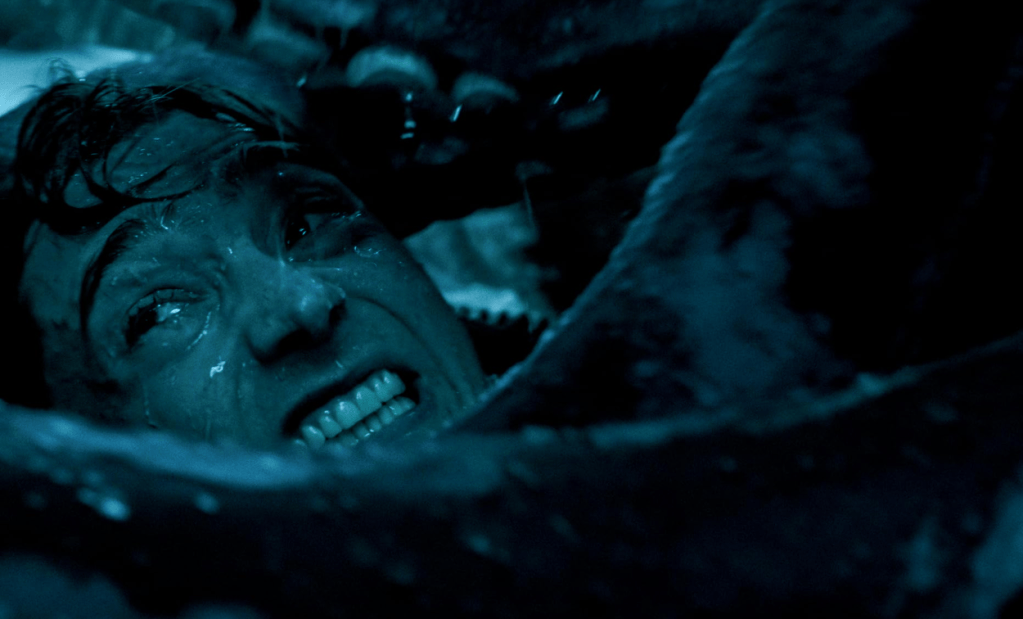
Will you believe me if I tell you that Austin Abrams has it worse in Whalefall than in Resident Evil? He just went through a full-blown zombie apocalypse, and now he is a grieving diver who gets literally swallowed by a whale. You see, in Resident Evil poor Bryan could run around and get a brand new weapon upgrade from time to time, but Jay doesn’t get even that little in the esophagus of a giant whale, where we spend most of the movie.
Like other one-location films, this one breaks up the claustrophobia (and ick, to be honest) of being in an extremely tight space by dividing the different acts with flashbacks retelling the conflictive relationship between Jay and his late, mercurial father (Josh Brolin). The present-day thriller scenes work wonderfully in building an awful sense of dread in a seemingly unsurvivable situation, while still adding enough variety to make it seem like progress is being made in some way. Abrams, who has played hateful, slimy dirtbags in the past, can transform into someone deeply likable in this last couple of films: it’s impossible not to root for this poor guy who has the worst luck imaginable.
The flashback scenes, on the other hand, drag the whole thing down; I am not against their role in bringing in some fresh air and sunlight into an otherwise oppresive movie, but the writing (by director Brian Duffield, adapting a novel of the same name by Daniel Kraus) falls short on two levels. Firstly, Jay’s father is only tolerable because of Brolin’s own rugged charisma, because as a character he is so toxic and so unhinged that the story never makes the point of why Jay feels so conflicted about his death when they really never seemed to share any good moments together. Secondly, the plot purpose of these flashbacks is for Brolin to deliver a hilariously on the nose survival tips that Jay can then put into practice in the present, which start out generic (like how to set up your oxygen tank) but grow increasingly specific to the unlikely -but admittedly possible!- event that Jay gets swallowed up by a whale. These interludes feel boring in the emotional side and eye-rolling in the functional side.
Overall, Whalefall is an effective, well-paced horror thriller, with the disclaimer that I really did have a terrible time of it, entirely because is so skilled at building the anguish of its protagonist. I guess that’s a recommendation with an asterisk!
La caída de la ballena
¿Me creerías si te dijera que Austin Abrams se lo pasa peor en La caída de la ballena que en Resident Evil? Acaba de pasar por un apocalipsis zombi en toda regla y ahora encarna a un submarinista traumatizado al que se lo traga una ballena. La cosa es que en Resident Evil podía corretear por ahí y de vez en cuando le daban un arma de videojuego, pero Jay no tiene ni eso dentro del esófago de la ballena en el que pasamos la mayor parte de la peli.
Como hacen otras películas que transcurren en una sola ubicación, esta alivia la claustrofobia (y el asquito, para ser sinceros) de estar encerrados en el interior de una ballena separando cada acto con flashbacks que narran la conflictiva relación de Jay con su difunto e irascible padre (Josh Brolin). Las escenas del presente infunden una sensación de tensión constante en una situación aparentemente imposible, aunque encuentran formas de darles variedad para que parezca que progresan poco a poco. Abrams, que ha interpretado a personajes repelentes y odiosos, es capaz de transformarse en alguien profundamente entrañable en este último par de proyectos: es imposible no empatizar con este pobre chico que tiene la peor suerte del mundo.
Los flashbacks, por el contrario, son un lastre total; no me parece mal su función de aportar algo de aire fresco y luz natural a una película por lo demás oscura y opresiva, pero el guion (escrito por el director, Brian Duffield, adaptando una novela de Daniel Kraus) fracasa en dos niveles. Primero, el padre de Jay solo resulta tolerable gracias al rudo carisma de Brolin, porque como personaje es tan tóxico y tan colérico que la historia nunca consigue articular por qué Jay tiene sentimientos encontrados hacia un padre con el que nunca pareció tener buenos momentos. Segundo, el propósito argumental de esas escenas es que Brolin reparta consejos de supervivencia que Jay pueda poner en práctica en el presente; al principio son consejos genéricos (como la forma de preparar la bombona de oxígeno) pero se vuelven tan específicos para el caso extremadamente improbable -¡pero posible!- de acabar dentro de una ballena que al final dan risa.
En general, La caída de la ballena es un thriller competente, con la advertencia de que me lo pasé fatal por lo bien que evoca la angustia de su protagonista. ¡Es una recomendación con asterisco!

