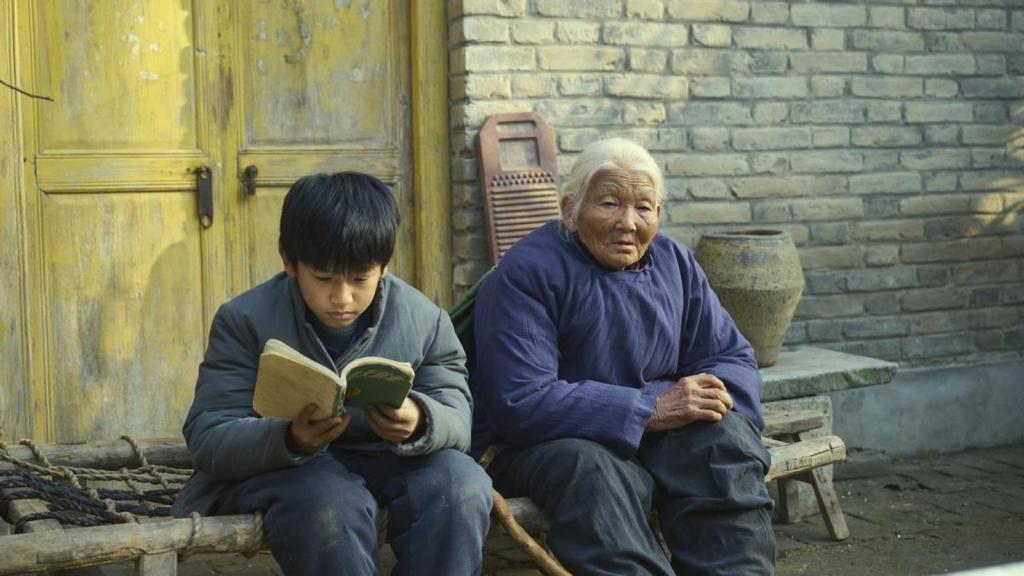
Living the Land, written and directed by Huo Meng (who won the Best Director award at the last Berlinale for this movie), is a highly naturalistic look at rural life in 1991 China, following mostly -but not only- a boy named Chuang (Wang Shang) who has been left behind in his village after his parents migrated with his other siblings to Shenzhen. Through his eyes we are introduced to the various relatives who inhabit his wheat-growing village, each a world unto themselves.
I can’t recall another movie that looked at farm life with an eye that was so loving while simultaneously being brutally unsentimental. It’s not even a case of “well the people are good but their material circumstances make life hard”: sure enough, life is ruthless in the furthest reaches of China’s still poor countryside, all sorts of disasters -natural or otherwise- can befall at any minute, but likewise some people are cruel and take out their misery on others. Huo’s eye catches moments of stunning pain that feel like a punch to the gut, sometimes explicitly, sometimes implied in a throwaway comment.
But with the same ease he manages to capture the unconditional love of a good person; think of the elderly great-grandma (Zhang Chuwen), whose marriage was arranged when she was six and had her first child at sixteen, by any metric the character you might expect to be the most jaded or set in her ways, but is instead a well of compassion towards children, the developmentally disabled cousin Jihua, or the suffering Xiuying (Zhang Yanrong), herself a young, selfless woman who desperately wants Chuang to study and have the kind of life she no longer envisions for herself. Most characters, even the stricter ones, converge in their desire to protect Chuang, in a way that makes us feel protective of the kid too.
While the story happens at a slow, progressive pace that feels almost documentarian, Huo’s filming style is unmistakably cinematic, with frequent shots of natural tableaus bathed in natural light of immense beauty or long, tracking sequences that highlight the interconnectedness of the village.
Living the Land is extremely slow and a tad too long, so it’s not for everyone, but I found it to be deeply moving, with a beauty both aesthetic and thematic.
Vivir la tierra (2026)
Vivir la tierra, escrita y dirigida por Huo Meng (quien ganó el premio a mejor director por esta película en la última Berlinale) es un retrato altamente naturalista de la vida rural en la China de 1991, centrada sobre todo (pero no exclusivamente) en un niño llamado Chuang (Wang Shang) que se ha quedado en su aldea natal después de que sus padres y sus demás hermanos emigren a Shenzhen. A través de su mirada vamos conociendo a los distintos parientes que viven de cultivar trigo en ese pueblo, cada uno un mundo.
No recuerdo ninguna otra película que reflexione sobre la vida rural con tanto amor y a la vez sin ápice de sentimentalismo. Ni siquiera es que diga “Bueno, las personas son buenas, es solo que sus circunstancias materiales son difíciles”: efectivamente, la vida en el campo aún pobre de China es inmisericorde, cualquier desastre (natural o artificial) puede acaecer en cualquier momento, pero también hay personas crueles que desfogan sus frustraciones en los demás. La mirada de Huo captura momentos de un dolor indescriptible, a veces explícitamente, a veces insinuados como de pasada en un comentario de fondo.
Sin embargo, evoca con igual facilidad el amor incondicional de una buena persona, por ejemplo el de la anciana bisabuela (Zhang Chuwen), cuyo matrimonio se concertó cuando tenía seis años y que dio a luz a su primer hijo con solo dieciséis: cualquiera podría esperarse que fuera la más amargada o anticuada de todos, pero en realidad es una fuente inagotable de compasión hacia los niños, el primo con discapacidad cognitiva, o la pobre Xiuying (Zhang Yangron), a su vez una joven abnegada que anima a Chuang a seguir estudiando para que disfrute de una vida que ya no se imagina para sí. Casi todos los personajes, hasta los menos amistosos, tienen en común su deseo de proteger a Chuang, lo que nos hace sentirnos protectores a nosotros también.
Aunque la historia transcurre con un ritmo lento y progresivo que parece casi documental, el estilo formal de Huo es decididamente cinematográfico, repleto de composiciones naturales bañadas por la luz del sol o largos planos secuencia que recalcan las interconexiones del pueblo.
Vivir la tierra es lenta y se hace lenta, especialmente hacia el final, así que no es para cualquiera. A mí me ha conmovido su belleza tanto estética como temática.

