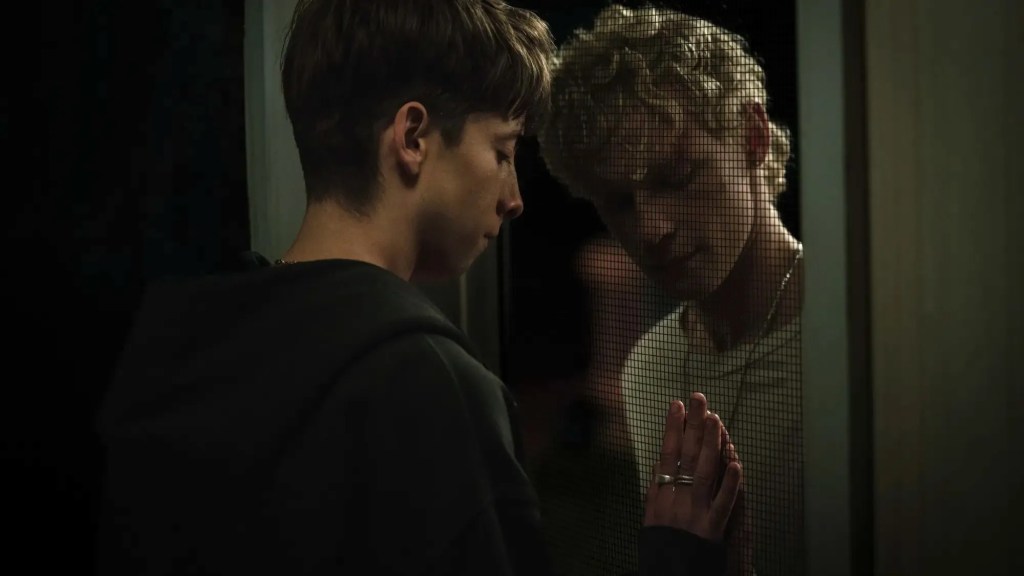
Leviticus has such a cool horror concept: in backwater Australia, two teenagers called Naim and Ryan (played by Joe Bird and Stacy Clausen respectively) fall in love with each other but are cursed by their homophobic, fundamentalist Christian families (which includes Mia Wasikowska as Naim’s unloving mother) to be hunted by a murderous supernatural entity that takes on the appearance of that they desire most: each other.
This movie follows The Backrooms and Obsession in a number of ways; for starters, in being the first feature film of a young director (Adrian Chiarella), finding unexpected critical and commercial success on a shoestring budget, or the one that interests me more: making good horror with a compelling allegory that nevertheless operates on only one level, the surface. When I remember something like Get Out, the metaphor there wasn’t just “white people are evil towards black people”: if you want to study its themes, the movie gives you material to understand that it’s also speaking about how American culture exploits the talents of black artists and athletes but doesn’t want their thoughts or opinions. With Obsession, the theme is all there on the first reading.
With Leviticus, the obvious allegory is homophobia, which turns gay love into something to be feared, contaminating desire with danger. Naim and Ryan are drawn to each other, while at the same time fearful that their love may be leading them to their death.
At a brisk 90 minutes, the movie is well paced, the horror scenes work more out of the emotional violence of mistrust and betrayal than for the violence itself, and the two leads really endear themselves in their helplessness. I wasn’t sold on the ending, which feels a little like Chiarella wrote himself into a corner with the premise, but I also acknowledge that it at least ties into the theme: one failing of movies like The Substance or Sinners is that once they enter the final act, their thematic work is over, and what’s left is just plot. Leviticus is not perfect, but it follows through on its theme.
Leviticus (2026)
Leviticus es una película de terror con un gancho excepcional: en la Australia más recóndita, dos adolescentes llamados Naim y Ryan (Joe Bird y Stacy Clausen, respectivamente) se enamoran pero sus familias, cristianos fundamentalistas homófobos (entre los cuales se cuenta Mia Wasikowska interpretando a la indiferente madre de Naim), los maldicen de forma que los persiga una entidad asesina sobrenatural que adopta el aspecto de lo que uno más desea: es decir, se le aparece a cada uno con la apariencia del otro.
Es una película que sigue a The Backrooms y Obsession en más de un sentido; para empezar, es el primer largometraje de un director joven (Adrian Chiarella) y ha obtenido un éxito de crítica y público con un presupuesto ínfimo, pero me interesa más otra similitud entre estos proyectos: son excelentes pelis de terror desarrolladas alrededor de una premisa interesante pero primaria. Cuando recuerdo Get Out, por poner un ejemplo, la metáfora no era solamente “los blancos maltratan a los negros”; si uno está dispuesto a reflexionar sobre la historia, el texto aporta material suficiente para hablar también de cómo la sociedad americana explota el trabajo de los artistas y deportistas negros pero rechaza sus derechos u opiniones. Con Obsession, sin embargo, toda la temática se queda en el primer nivel, en la superficie.
En Leviticus, la alegoría es evidentemente la homofobia, que vuelve el amor homosexual en algo a temer, contaminando el deseo con el peligro. La atracción que Naim y Ryan sienten mutuamente es a la vez una verdadera amenaza de muerte.
Con apenas 90 minutos de duración, la película está muy bien montada, las escenas de terror funcionan más por la violencia emocional de la traición y la desconfianza que por la violencia misma, y los dos protagonistas se hacen querer en su angustia. No me ha convencido el final, que sugiere que Chiarella no supo dar con un buen desenlace para la premisa, pero hay que reconocer que al menos encaja con la temática: un problema de pelis como La sustancia o Sinners es que una vez entrados en el último acto, todo el desarrollo del tema ya ha concluido y solo queda argumento. Leviticus puede ser imperfecta, pero sigue su temática hasta el final.

