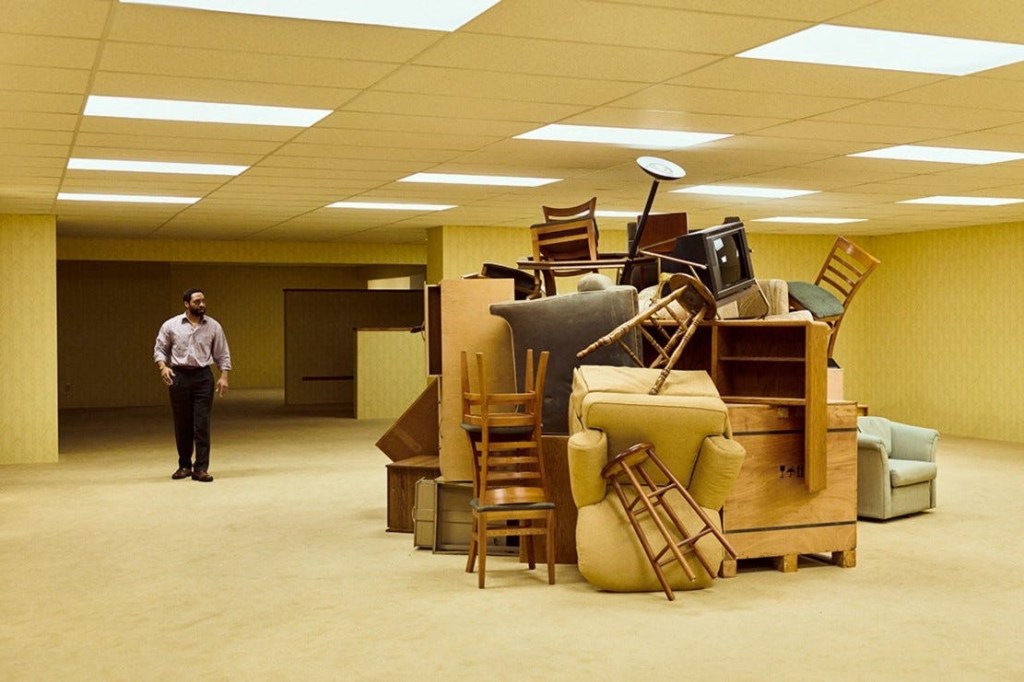
The box office phenomenon of 2026 so far is that two low-budget independent horror features, Backrooms and Obsession, are raking in hundreds of millions of dollars worldwide while studio blockbusters like The Mandalorian and Grogu and Masters of the Universe underperform or straight up tank, respectively. It’s hard to say what exactly this says about the industry, but I want to believe it is proof that not only is there life outside Hollywood, but that audiences are still happy to go out to theaters when offered something engaging for a change.
Today’s subject of conversation, Backrooms, is adapted from an internet myth of sorts, a scary supernatural location based on the concept of liminal spaces: transitional places that we routinely traverse but rarely linger in, like airport hallways, service corridors, or sure enough, the backrooms of a furniture store. We don’t pay attention to these places, but when we do, they can look wrong somehow, like we’re noticing something we shouldn’t be; the Japanese horror movie Exit 8 recently explored this concept in its own way.
For this movie, 20-year-old writer and director Kane Parsons has brought the backrooms to life through the characters of Clark (Chiwetel Ejiofor), the owner of a failing furniture store who finds a supernatural, cavernous succession of rooms in his store’s basement, and Mary (Renate Reinsve, the worst person in the world), his therapist who gets dragged into exploring the terrifying depths of a space that doesn’t obey the laws of time and space where you are never truly alone.
The realization of a fully coherent, atmospheric space out of one blurry picture and a forum post is certainly the film’s greatest achievement, but for me the reason it works so well is that Parsons has written the horror premise into his characters and their themes. There are horror movies that loftily claim to be about, say, grief, when they just have horror stories happen to characters who are grieving. In movies like Hereditary and The Invisible Man, however, the horror is inextricable from the theme.
Where in the latter the invisible man is a personification of gaslighting and abuse, here the backrooms are reimagined as a manifestation of our own behavioral loops: the harder we attach ourselves to our familiar patterns, the more restrictive they become. Mary helping Clark break out of his blinkered self-pity translates into her trying to find him in the endless maze in his basement.
It doesn’t hurt, of course, to have two immensely talented actors like Ejiofor and Reinsve as leads, imbuing their characters with a pathos that the script would otherwise not have time to fully fledge. The production design is effectively the third protagonist, too, making an infernal dimension out of cheap, corporate carpet and wallpaper.
In all, Backrooms is a great chance to have a stressful time at the movies. When Hollywood is reduced to lowest possible effort nostalgia, we can turn to independent filmmakers to break new ground and explore complex themes.
Backrooms (2026)
En lo que llevamos de 2026, el fenómeno cinematográfico más interesante que estamos viendo es sin duda que dos películas de terror independientes de bajo presupuesto, Backrooms y Obsession, están recaudando cientos de millones de dólares en todo el mundo mientras que grandes superproducciones de estudios como The Mandalorian and Grogu y Masters of the Universe apenas recuperan lo puesto o directamente fracasan en taquilla, respectivamente. Es difícil adivinar lo que augura para el futuro, pero yo quiero pensar que es prueba de que la gente sigue queriendo ir al cine cuando puede ver algo creativo o interesante.
Hoy hablamos de Backrooms, una adaptación de una especie de mito de internet sobre un lugar sobrenatural basado en el concepto de “liminal spaces” o espacios transitorios como los pasillos de los aeropuertos, las áreas de servicio de los centros comerciales, o efectivamente la trastienda de una tienda de muebles. Son sitios que cruzamos habitualmente pero en los que rara vez nos paramos, y si les prestamos atención a veces tienen un aire inquietante porque no están hechos para ser observados. Hace poco Exit 8 exploró un concepto similar con los interminables pasillos de una estación de metro.
En esta película, Kane Parsons, director y guionista de tan solo veinte años, se adentra en esa trastienda mediante los personajes de Clark (Chiwetel Ejiofor), el dueño de una tienda de muebles al borde de la bancarrota que encuentra una serie de salas misteriosas en su sótano, y Mary (Renate Reinsve, la peor persona del mundo), su psicóloga, que acaba teniendo que explorar las profundidades de un infierno que no se atiene a las leyes de la física.
Retratar un espacio coherente y aterrador a partir de una foto borrosa y un mensaje en un foro es sin duda el gran logro cinematográfico de Parsons, pero para mí la razón por la que funciona tan bien es que la premisa es inseparable de los personajes y la tesis de la historia. Hay películas de terror que presumen de ser un estudio del trauma cuando simplemente son cosas de terror que les pasan a personajes con trauma. En pelis como Hereditary o El hombre invisible, sin embargo, el terror radica en la temática: en esta última, el hombre invisible es la personificación de la luz de gas y el abuso. En Backrooms, la trastienda es una manifestación de nuestras tendencias: cuanto más nos aferramos a nuestras rutinas y a nuestros patrones de comportamiento, más nos asfixian y restringen. Mary intenta ayudar a Clark a romper su patrón de autocompasión en terapia y acaba teniendo que buscarlo en el laberinto infinito de su sótano.
Naturalmente, ayuda tener dos actores sobresalientes como Ejiofor y Reinsve insuflar a sus personajes con una gravedad que sin ellos el guion no acabaría de definir. La producción es en cierto modo el tercer protagonista, creando una dimensión alternativa mediante la moqueta barata y el papel pintado de la mediocridad corporativa.
En resumen, Backrooms es una gran oportunidad para pasarlo mal en el cine. Es un alivio saber que en esta época en la que Hollywood invierte el mínimo esfuerzo posible en producir morralla nostálgica, podemos contar con directores independientes para explorar nuevas ideas.
 The Film Tower